Two Umatilla High School (UHS) students who represented Oregon in a national conversation about artificial intelligence in education this summer are continuing to share their experience and perspectives with leaders closer to home.
September 9th, at the invitation of State Senator Lew Frederick, Wyatt and Soraya testified before the Oregon Senate Interim Committee on Education Sen. Frederick chairs. This was a hearing on education policy related to artificial intelligence. The students shared their experience at the Day of AI event and the Students First Act they helped develop with fellow student senators in Boston this July.
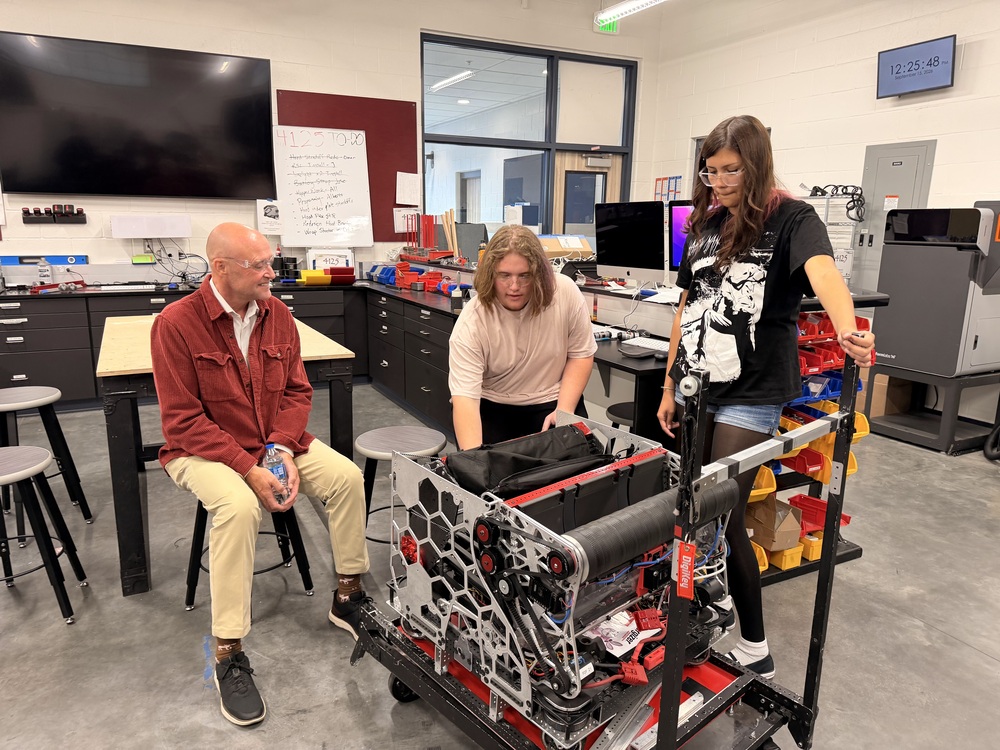
Less than a week later, Wyatt and Soraya were able to continue this conversation with Representative Greg Smith. During a visit to the Umatilla School District on September 15, Smith joined Wyatt and Soraya for lunch and heard about their experience.
The students answered questions about traveling to Boston, testifying before the Senate committee, and some of the larger questions surrounding AI in education, including its potential effects on critical thinking and how AI also affects parents and teachers.
Their overall message was AI should be used as a tool, much like a calculator. It should not be used to replace critical thinking skills. Smith congratulated the students on the opportunities they had taken part in and their role in representing Oregon.
Smith also shared about his own experiences in public office. He talked about what he learned when he first entered office and offered advice to the students as they continue to take part in conversations with varying opinions.
In July, sophomores Wyatt Wilhelm and Soraya Rincon traveled to Boston as Oregon's representatives at the Student Senate on AI Policy event. The event brought together high school students representing all 50 states to discuss the future of artificial intelligence in education and develop recommendations for how AI should and should not be used in schools.
Umatilla High School was selected by the AASA Oregon Delegation to send student representatives because of its strong STEM and robotics programs. Wyatt and Soraya are leaders for both programs in the Umatilla School District. They are also engaged in the early college program at UHS, an opportunity that gives them the chance to earn credits from Arizona State University, Blue Mountain Community College, and Umatilla High School.
While at the AI Policy event, Wyatt and Soraya stepped into the role of student senators, working alongside their peers to discuss, debate, and vote on the use of AI.
"There were lots of diverse opinions," Wyatt said. "Some student senators were in favor of AI in school while others were completely against the idea and said it should not be in schools at all."
Working through those different perspectives was an important part of the experience. Wyatt said some students were more open to hearing other people's ideas than others, making navigating those conversations an interesting experience and one he learned a lot from.
The students' work ultimately resulted in the Students First Act, a student-created framework addressing AI literacy and academic integrity. The student senators approved the proposal and Wyatt and Soraya have had the opportunity to bring this experience directly to state leaders.
Umatilla High School Principal Rick Cotterell and Human Resources Coordinator Josy Chavez, a former Umatilla city councilor, accompanied Wyatt and Soraya as chaperones and also participated in the event. The Umatilla School District was thankful that travel expenses were supported by Amazon, helping make this the next opportunity they supported for its students.
“Amazon is proud to support students like Wyatt and Soraya as they lead on the national stage and represent the STEM excellence happening right here in Eastern Oregon,” said Benjamin Harvey, Amazon’s Community Engagement Manager.
Each opportunity has given Wyatt and Soraya a new perspective on what it means to have a voice in conversations that affect their education. Their experiences have been more than learning about AI. It has challenged them to listen to different perspectives, share their own ideas, and take part in conversations about issues that directly affect students. As schools continue to navigate the role of AI in education, they hope student voices will continue to have a place in that conversation.